
Why Thick Distillate Clogs Cartridge Filling Nozzles—and Which Settings Fix It
Thick distillate can turn an otherwise stable filling process into a frustrating cycle of slow dispensing, inconsistent fill weights, oil stringing, and clogged nozzles.
The problem is usually not the nozzle alone. In a distillate cartridge filling machine, clogging is often caused by the interaction between oil viscosity, temperature across the fluid path, filling speed, nozzle condition, and equipment design.
The solution is therefore not simply to “add more heat.” The goal is to keep the oil at a stable, workable viscosity from the reservoir to the dispensing point while maintaining repeatable dosing.
Key Takeaways
- High viscosity is one of the main reasons thick distillate becomes difficult to dispense through narrow filling nozzles.
- Heating only the oil reservoir may not be enough if the material cools in the pump, tubing, or nozzle area.
- Filling speed should match the actual flow behavior of the oil rather than the machine's maximum rated speed.
- Persistent clogging can also indicate residue, a restricted flow path, or unsuitable nozzle geometry.
- The best settings depend on the formulation, cartridge, dose, and production target—there is no universal temperature for every distillate.
Why Does Thick Distillate Clog Cartridge Filling Nozzles?
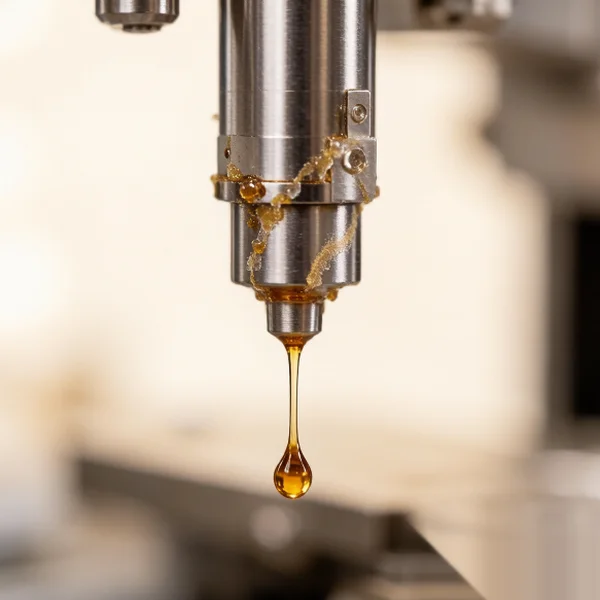
The primary reason is viscosity.
Distillate becomes much more resistant to flow as its temperature decreases. A cartridge filling system must move that material through a reservoir, metering or pumping system, transfer path, and finally a relatively narrow dispensing nozzle.
If the oil becomes too viscous anywhere along this path, flow resistance increases.
A complete blockage is usually not the first warning sign. Operators may initially notice:
- Slower dispensing.
- Inconsistent fill weights.
- Incomplete shots.
- Oil stringing from the nozzle.
- Delayed cut-off.
- Increasing cycle times.
These symptoms matter because what appears to be a “nozzle problem” may actually be a broader temperature or flow-control problem.
Before replacing a nozzle, determine whether the oil is reaching it under stable conditions.
Why Heating the Reservoir Alone May Not Fix Nozzle Clogging
A common mistake in high viscosity cartridge filling is focusing only on tank temperature.
Heating the reservoir can make thick distillate easier to pump, but the oil still has to travel through the rest of the machine.
If warm oil leaves the reservoir and enters a cooler pump or transfer line, its viscosity can increase again before it reaches the nozzle. The reservoir temperature may look correct while dispensing remains unstable.
This is why temperature control across the fluid path matters.
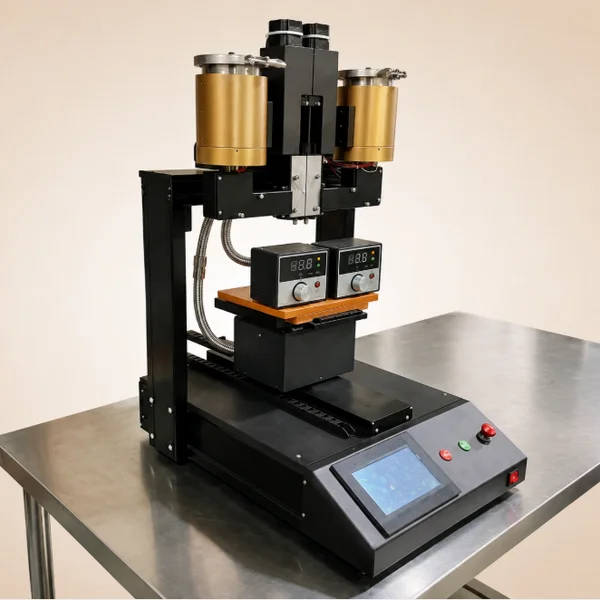
Longwill's automatic cartridge filling equipment, for example, provides separate temperature control for the oil reservoir and pump/line path, with an adjustable heating range of 0–120°C.
The wide equipment range should not be interpreted as a recommended oil temperature. Instead, independent heating zones allow operators to establish suitable conditions for different formulations.
For thick distillate, the important question is not simply:
“Is the tank hot enough?”
It is:
“Is the oil maintaining a workable viscosity throughout the filling path?”
What Temperature Should You Use for Distillate Cartridge Filling?
There is no single temperature setting that works for every distillate.
Longwill's existing distillate filling guide notes that many operators work around 40–55°C (104–131°F) when preparing distillate for filling. This can be a useful starting reference, but formulation differences mean the actual process should be validated for the material being filled.
The practical target is the lowest stable temperature that allows consistent flow and repeatable dosing at the required production speed.
More heat is not automatically better.
Instead of immediately raising temperature when a nozzle slows down:
- Allow the oil and heated fluid path to stabilize.
- Prime the filling system.
- Run several test fills.
- Check flow behavior and actual fill consistency.
- Adjust temperature gradually if necessary.
This gives operators a repeatable process window instead of relying on a single temperature number copied from another formulation.
Which Distillate Cartridge Filling Machine Settings Should You Adjust?
When clogging occurs, change one variable at a time.
Changing temperature, speed, and dispensing parameters simultaneously may make the machine run again, but it will not reveal the real cause.
A more controlled troubleshooting sequence is useful.
| Setting or Condition | Typical Problem | What to Check |
|---|---|---|
| Reservoir temperature | Oil remains too thick | Actual oil temperature and warm-up time |
| Pump/line temperature | Oil cools after leaving tank | Temperature across downstream fluid path |
| Filling speed | Incomplete or unstable shots | Reduce speed and retest |
| Nozzle condition | Restricted or irregular flow | Check for accumulated residue |
| Idle time | Oil thickens between runs | Reheat and prime before restart |
| Fluid-path geometry | High resistance with thick oil | Confirm suitability for the formulation |
1. Stabilize Temperature First
Do not judge filling performance immediately after switching on the heaters.
The displayed temperature may reach its target before all the oil and downstream components have reached stable operating conditions.
Allow sufficient warm-up time, then prime the system before testing production fills.
If the machine works normally after warming up but starts clogging after a long pause, temperature loss during idle periods should be one of the first things investigated.
2. Reduce Filling Speed
If the oil is warm but dispensing remains inconsistent, reduce the filling speed before simply adding more heat.
A high cycle rate can demand material faster than thick oil can move consistently through the dispensing system.
If slower filling restores repeatability, the problem may be the relationship between viscosity and throughput rather than a physically blocked nozzle.
This is particularly important when comparing a distillate cart filling machine based on advertised speed.
Maximum theoretical output matters less than the speed the machine can maintain with your actual formulation.
3. Inspect the Nozzle and Fluid Path
If temperature and speed adjustments do not solve the issue, inspect the physical flow path.
Residual distillate can gradually restrict the effective opening of the nozzle or other wetted components. Once the equipment cools, this residue may become even more difficult to move.
A clean fluid path should therefore be established before continuing to increase temperature or dispensing force.
How Can You Identify the Cause of Cartridge Filler Nozzle Clogging?
The timing and pattern of the problem often provide useful clues.
Clogging Happens Immediately After Startup
Insufficient warm-up is a likely cause.
Allow the reservoir and heated dispensing path to stabilize, prime the machine, and run a small test batch.
Filling Starts Normally but Gets Worse Over Time
Check whether temperature remains stable throughout the complete fluid path.
Also inspect for progressive residue buildup in the nozzle.
The Machine Works at Low Speed but Fails at High Speed
The selected production rate may exceed the stable flow rate of the oil.
Reduce dispensing speed and gradually increase it until you identify the fastest setting that still maintains repeatable filling.
Only One Nozzle Has a Problem
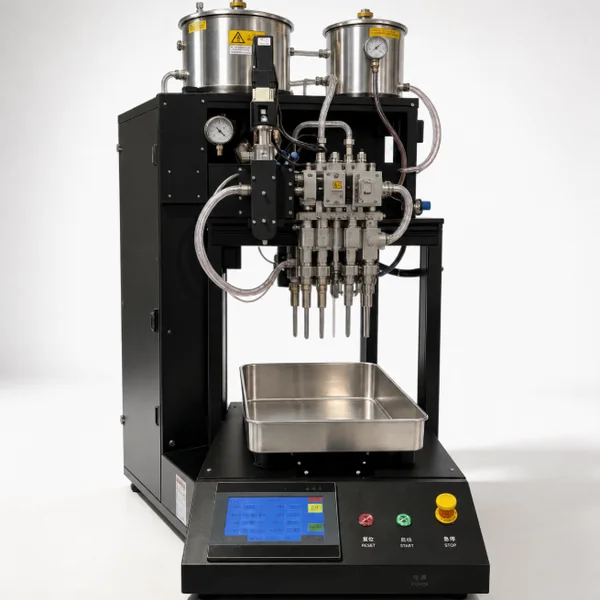
On a multi-nozzle machine, one problematic filling head while others work normally suggests a localized issue.
Inspect that nozzle and its individual fluid path before changing temperature settings for the entire system.
Fill Weight Drifts Before the Nozzle Clogs
Do not wait for a complete blockage.
Increasing fill variation can be an early warning that the flow conditions are becoming unstable.
Check temperature, priming, nozzle condition, and calibration before continuing full production.
Why Cleaning Matters With Thick Distillate
Temperature problems and dirty nozzles can produce very similar symptoms.
Residual oil left inside a nozzle or transfer path may become increasingly difficult to move as the equipment cools. On the next production run, the remaining material reduces the effective flow area.
That increases resistance and makes thick oil even more difficult to dispense.
This is why cleaning is part of process control, not simply routine maintenance.
If a machine previously filled the same formulation correctly but gradually develops problems over repeated production runs, inspect the fluid path before changing the process recipe.
Do not compensate for residue by continuously increasing temperature or dispensing force.
Restore the machine to a known clean condition first.
A Practical Troubleshooting Sequence for Thick Distillate
When cartridge filler nozzle clogging occurs, use a consistent sequence:
Step 1: Pause production.
Avoid continuing to fill units when dispensing has become unstable.
Step 2: Check the material condition.
Confirm that the oil is uniformly heated and behaving as expected.
Step 3: Verify the complete temperature path.
Check both reservoir and downstream heating zones where available.
Step 4: Inspect the nozzle.
Look for residue or localized restrictions according to the machine's cleaning procedure.
Step 5: Prime the system.
Confirm stable oil output before filling production cartridges.
Step 6: Reduce dispensing speed.
Run several controlled test fills.
Step 7: Verify actual fill results.
Check fill consistency rather than judging the process only by visual flow.
Step 8: Increase speed gradually.
Once the process is stable, move toward the required production rate while continuing to monitor repeatability.
Changing one factor at a time makes it much easier to identify the real cause and document reliable settings for future batches.
When Is the Cartridge Filling Machine Itself the Problem?
If nozzle clogging continues despite stable temperature, proper cleaning, and reasonable dispensing speeds, the equipment may not be well matched to high-viscosity oils.
For thick distillate, a distillate cartridge filling machine should be evaluated on more than units per hour.
Look at whether the machine provides:
- controlled heating beyond the reservoir.
- independently adjustable heating zones.
- adjustable filling speed and dose parameters.
- a fluid path suitable for viscous oils.
- practical cleaning and changeover.
- compatibility with the intended cartridges, pods, or disposable devices.
Longwill's automatic filling platform uses independent reservoir and pump/line temperature control together with adjustable filling parameters. This allows the filling process to be tuned around different oils and hardware instead of depending on one fixed recipe.
That flexibility becomes especially valuable when a manufacturer processes several formulations with different viscosity characteristics.
How Should You Test a Distillate Cart Filling Machine?
Before full production, run a controlled trial using the actual oil and cartridge whenever possible.
Record:
- formulation or batch.
- reservoir temperature.
- downstream heating setting.
- warm-up time.
- filling speed.
- target dose.
- actual fill results.
- nozzle behavior.
Then change one variable at a time.
For example, if the formulation fills accurately at a moderate speed but becomes inconsistent when production speed increases, you have identified a practical throughput limit for that combination.
If clogging appears only after long idle periods, startup and restart procedures may require more attention.
If only one nozzle becomes unstable, investigate that individual dispensing path.
These observations provide far more useful information than simply recording that the machine “clogged.”
What Should You Look for When Buying a High-Viscosity Cartridge Filling Machine?
The most useful purchasing question is not:
“What is the maximum filling speed?”
Instead ask:
“How consistently can this machine fill my oil into my hardware at the production speed I need?”
A high advertised throughput provides little value if operators repeatedly stop production to clear nozzles or correct inconsistent fills.
For thick distillate, prioritize:
Temperature control. The system should maintain workable oil conditions through the relevant dispensing path.
Adjustable parameters. Filling speed and dosing should be adaptable to different formulations.
Hardware compatibility. Nozzle and filling configuration should match the actual cartridges, pods, or disposable devices.
Cleaning accessibility. Operators should be able to restore the fluid path efficiently between batches or formulations.
Repeatability. Evaluate whether the machine maintains consistent fills during sustained operation, not only during the first few cycles.
The goal is stable real-world production rather than the highest number on a specification sheet.
Final Takeaway
Thick distillate does not automatically mean cartridge filling nozzles have to clog.
Repeated clogging usually indicates that some part of the process has moved outside a stable operating window. The oil may be too viscous somewhere in the fluid path, the filling speed may be too aggressive, residue may be restricting the nozzle, or the machine may not provide sufficient control for the formulation.
Start with temperature stability across the complete oil path. Then check dispensing speed, nozzle condition, priming, and actual fill consistency.
Most importantly, avoid searching for one universal “best” temperature.
A suitable distillate cartridge filling machine should allow the operator to establish a repeatable process around the actual oil, cartridge, dose, and production target.
FAQ
1.Why does my distillate cartridge filling machine keep clogging?
Common causes include high oil viscosity, insufficient or uneven heating, excessive filling speed, residue inside the nozzle, or a fluid path poorly suited to the formulation. Check temperature stability and nozzle condition before increasing dispensing force.
2.What temperature should distillate be for cartridge filling?
There is no universal setting. Many operators use approximately 40–55°C (104–131°F) as a starting reference, but the appropriate temperature depends on the formulation and equipment. The objective is stable flow and repeatable dosing without unnecessary heat exposure.
3.Why does my cartridge filler work at low speed but clog at high speed?
The oil may not be able to move through the dispensing path consistently at the higher cycle rate. Reduce filling speed and increase it gradually while monitoring actual fill consistency.
4.What matters most when choosing a filling machine for thick distillate?
Prioritize temperature control across the oil path, adjustable dispensing parameters, compatibility with your hardware, accessible cleaning, and repeatable filling with your actual formulation.
Table of Contents