
Cartridge Filling Gun vs Machine for Small-Batch Production
A cartridge filling gun and a bench-top filling machine can both be used to dispense oil into vape cartridges, but they handle the work differently. The real differences appear when you look at how much oil the equipment holds, how the material is heated, how the dispensing tip is positioned, and what the operator needs to do between filling cycles.
For a manufacturer preparing occasional batches, a compact cartridge filling gun may provide the necessary dispensing functions without a larger material-supply system. For repeated production, a bench-top machine can offer more reservoir capacity and additional control options.
The right choice is not simply the smaller or faster device. It is the filling arrangement that matches the material, cartridge, and work involved in each production session.
Quick Answer
A cartridge filling gun is suitable for small batches requiring compact, handheld dispensing. A bench-top cartridge filling machine offers larger reservoir options and more operating controls for repeated filling. Compare oil capacity, heating design, material-path cleaning, and cartridge handling before choosing.
Key Takeaways
- A cartridge filling gun can include powered heating and controlled dispensing; it is not necessarily an ordinary manual syringe.
- Reservoir capacity affects how often the operator must replenish oil, while a short oil path can make material-contact components easier to access.
- Internal heating and multi-zone heating serve different equipment arrangements, but neither guarantees compatibility with every formulation.
- Bench-top equipment becomes worth considering when larger material supplies, programmable controls, or repeated filling operations are required.
What Makes a Cartridge Filling Gun Different From a Filling Machine?
The difference begins with the arrangement of the dispensing system.
A cartridge filling gun places the filling assembly close to the operator's hand. The user directs the dispensing tip toward the cartridge opening and controls its position during filling. Depending on the model, heating and dosing functions may be supported by electronic controls rather than being performed entirely by hand.
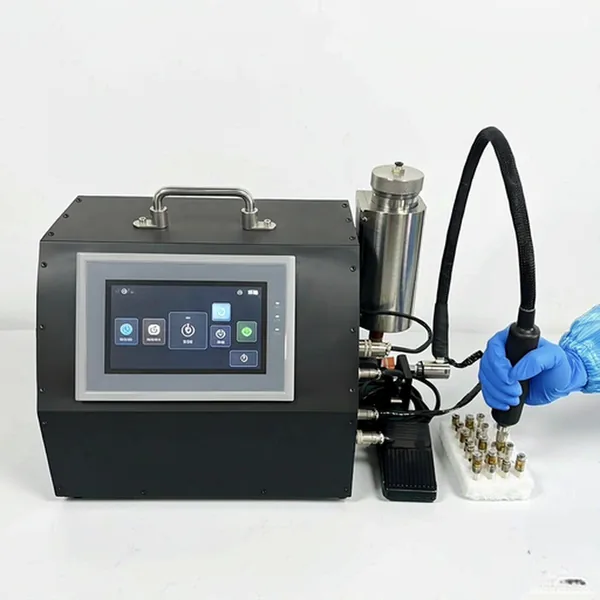
A bench-top cartridge filling machine typically uses a separate reservoir and control assembly. Material is delivered to the dispensing tip through the machine's pumping or feeding arrangement, while the operator interacts with a control panel, handheld nozzle, pedal, or positioning system.
Neither term defines a specific level of dosing accuracy. A larger machine is not automatically more precise, just as a filling gun is not necessarily a manual syringe.
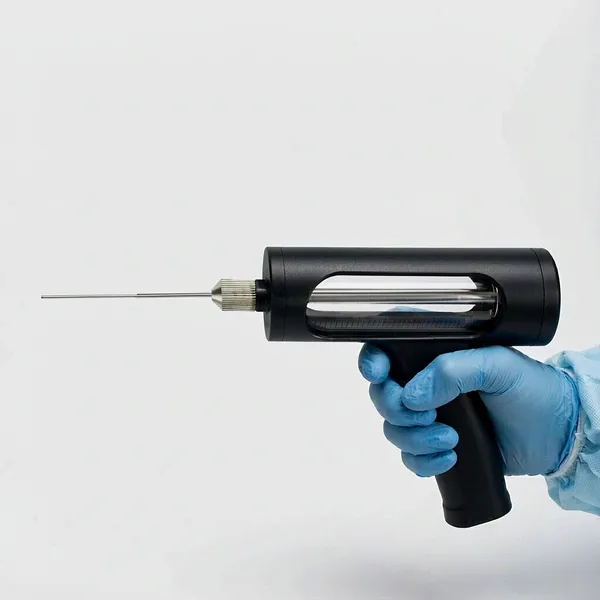
Inside the Longwill FM03 Cartridge Filling Gun
The Longwill FM03 Semi-Auto Cartridge Filling Gun is a compact example of heated handheld dispensing equipment.
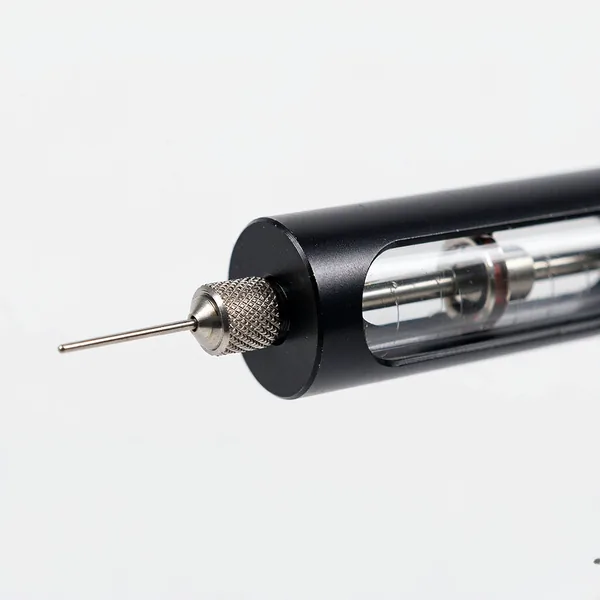
Its construction includes a transparent 50 mL glass oil reservoir, an internal heating rod, adjustable temperature control, and a short dispensing path. The reservoir can be removed for material handling and cleaning.
This arrangement brings several functions into a relatively small assembly.
The transparent reservoir makes the remaining material visible during operation. Internal heating provides temperature control close to the contained oil, while the removable container and short flow path provide access to important material-contact areas.
The operator still guides the filling tip and must position the cartridge correctly. The equipment's compact size does not remove the need for stable handling, suitable dispensing settings, or the correct filling needle.
The FM03 is therefore better understood as a heated semi-automatic filling gun, rather than a conventional manual syringe or a fully automated cartridge filling station.
Why Reservoir Size Matters for Small-Batch Filling
Reservoir capacity is one of the most practical differences between compact filling guns and larger filling machines.
A small reservoir may be convenient when working with limited material quantities. A larger reservoir becomes more useful when the same formulation is dispensed repeatedly over a longer session.
However, larger capacity is not automatically better. The amount of material prepared should reflect the production batch, the equipment's material-holding requirements, and the formulation's handling conditions.
What Does a 50 mL Reservoir Mean in Practice?
The FM03 uses a 50 mL glass reservoir.
To understand what this means, consider a simple material-balance example. A batch of 40 cartridges with a target fill of 1 mL requires a nominal 40 mL of oil inside the finished cartridges.
A 50 mL reservoir has enough nominal capacity to hold that quantity, but this does not establish that all 40 cartridges can be completed from a single fill. Some material may remain in the equipment, and the amount actually available for dispensing depends on its design and operating procedure.
If the batch instead contains 100 cartridges at 1 mL each, the nominal material requirement becomes 100 mL. The FM03 would need replenishment because its reservoir cannot hold the entire quantity at once.
These examples are not productivity or oil-loss measurements. They simply show why reservoir capacity should be considered alongside the intended filling volume.
For occasional batches, a compact reservoir may be sufficient. When replenishment becomes a frequent part of a repeated filling session, a larger supply arrangement may be more convenient.
Does a Larger Reservoir Mean Less Waste?
Not necessarily.
Reservoir size affects how much material the equipment can hold, but oil remaining after production also depends on the dispensing system, tubing, nozzle, and cleaning procedure.
A larger reservoir does not automatically increase waste, and a small reservoir does not guarantee minimal residual oil.
The relevant questions are how much material must be prepared before filling, which components retain oil after the operation, and how those components are emptied or cleaned.
For a manufacturer handling valuable formulations in small quantities, these considerations can be more relevant than choosing the equipment with the highest nominal capacity.
How Do Heating and Oil Paths Differ?
Viscous oils require suitable material-handling conditions to move through a dispensing system. Heating may help adjust flow behavior, but the equipment's heating arrangement determines where temperature can be controlled.
A filling gun and a bench-top machine can approach this requirement differently.
Internal Heating in a Compact Filling Gun
The FM03 uses an internal heating rod positioned within its reservoir assembly.
Unlike a system that supplies material through an extended heated hose, this design keeps the principal reservoir and dispensing path close together.
The compact configuration may be useful when a manufacturer wants to handle a limited amount of material without preparing a larger external reservoir and transfer system.
However, the appropriate operating temperature depends on the formulation. A heating element does not mean that all oils should be processed at the same setting.
The heating arrangement must be considered together with the material's permitted handling conditions, the dispensing mechanism, and the filling needle.
Heating Across a Longer Material Path
A bench-top filling system may use a separate reservoir, pump, and dispensing hose.
In this arrangement, the oil travels through more components before reaching the cartridge. Temperature conditions along the path may need to be managed as part of the overall dispensing setup.
Longwill's Semi-Auto Cart Filler with Hand Hose provides separate temperature adjustment for the oil reservoir, pump, and handheld hose.
This is a different approach from the FM03's compact internally heated reservoir.
The multi-zone arrangement gives operators separate control points for different sections of the material path. Its usefulness depends on the formulation and the equipment configuration.
It should not be interpreted as proof that a longer or multi-zone system always produces better filling results. The appropriate design depends on how the material is supplied and dispensed.
Why a Short Oil Path Can Matter During Cleaning
The FM03's removable reservoir and short oil path are particularly relevant when considering access to material-contact components.
Cleaning a filling system requires attention to the areas that contact the oil. Depending on the equipment, these may include the reservoir, pump, tubing, nozzle, seals, and other wetted parts.
A compact system can reduce the number of components involved in the material path, although the actual cleaning procedure depends on its construction.
A longer dispensing arrangement may provide other operating advantages but can include more areas that need attention when changing material.
The important difference is not that one machine is automatically cleaner. It is how the material path is arranged, which components can be accessed, and what procedures are required between filling sessions.
Cartridge Filling Gun vs Machine: A Practical Comparison
For buyers comparing a filling gun with a bench-top cartridge filling machine, the most useful specifications describe the work each configuration requires.
| Selection factor | Cartridge filling gun, such as FM03 | Bench-top cartridge filling machine |
|---|---|---|
| Dispensing arrangement | Compact handheld filling assembly | Separate reservoir and equipment-control arrangement |
| Material reservoir | FM03 uses a 50 mL glass reservoir | Models such as FM10 offer 300 mL or 500 mL reservoir options |
| Temperature control | Internal heating within the compact assembly | May include reservoir heating or multiple temperature-control zones |
| Material path | Relatively short dispensing path | Depends on pump, tubing, and hose configuration |
| Cartridge positioning | Operator guides the filling tip | Handheld or machine-guided positioning, depending on model |
| Operating controls | Dedicated filling and temperature controls | May include touchscreen settings, pedal operation, and programmable dispensing |
| Cleaning considerations | Removable reservoir and accessible short-path components | Cleaning depends on the reservoir, pump, tubing, and dispensing arrangement |
| Main consideration | Compact material handling and direct positioning | Larger material supply and repeated operation |
This comparison does not establish that one configuration has better accuracy, lower material loss, or a shorter filling cycle in every application.
Those outcomes depend on the exact equipment, material, dispensing settings, and operator procedure.
The practical difference is how the equipment supports the work that takes place before, during, and after each fill.
What Are the Limitations of a Handheld Cartridge Filling Gun?
A compact filling gun offers direct handling, but its advantages have boundaries.
The first limitation is the operator's responsibility for positioning. The filling tip must reach the cartridge opening correctly, and the cartridge must remain stable during dispensing.
For compatible hardware with accessible filling openings, this may be straightforward. Narrow or awkwardly positioned openings can require suitable needle selection or additional cartridge support.
The second consideration is the reservoir. A 50 mL container is appropriate for certain material quantities, but longer filling sessions may require repeated replenishment.
A third factor is the repeated physical work. Handheld filling involves moving the tip between cartridges, activating the dispensing operation, and preparing the next device.
During occasional short sessions, these actions may be manageable. As identical filling tasks are repeated more frequently, the operator's movements become a more significant part of the workflow.
Finally, compact equipment has a specific material-handling architecture. Manufacturers needing a larger supply reservoir or separate control over different sections of a heated material path may find a bench-top configuration more suitable.
These are operating considerations rather than faults of the filling gun. They help define where the compact design is useful and where another equipment arrangement may offer practical advantages.
Which Longwill Filling Setup Should You Consider?
The choice between a filling gun and a machine does not have to jump directly from a compact handheld tool to a fully automatic production line.
Longwill offers different configurations for manufacturers who want to retain operator-controlled filling while changing how material is stored, heated, and dispensed.
FM03: Compact Heated Filling With a Short Oil Path
The FM03 is the most direct option to consider when the priority is compact handheld filling.
Its 50 mL transparent glass reservoir, internal heating rod, and removable design make it distinct from systems with larger external reservoirs.
It is worth evaluating when the planned batch size and material-handling requirements fit a compact reservoir and the operator can position the filling tip correctly.
FM10: A Larger Reservoir With Touchscreen Controls
The FM10 Smart Cart Filling Machine offers a different working arrangement.
It combines a 300 mL or 500 mL reservoir option with touchscreen controls, stepper-motor-driven dispensing, and pedal operation.
These features are relevant when production requires a larger material supply and more operating settings than a compact filling gun provides.
The FM10 still involves operator participation. It should not be confused with a fully automatic multi-nozzle filling line.
Semi-Auto Cart Filler With Hand Hose: Retaining Handheld Positioning
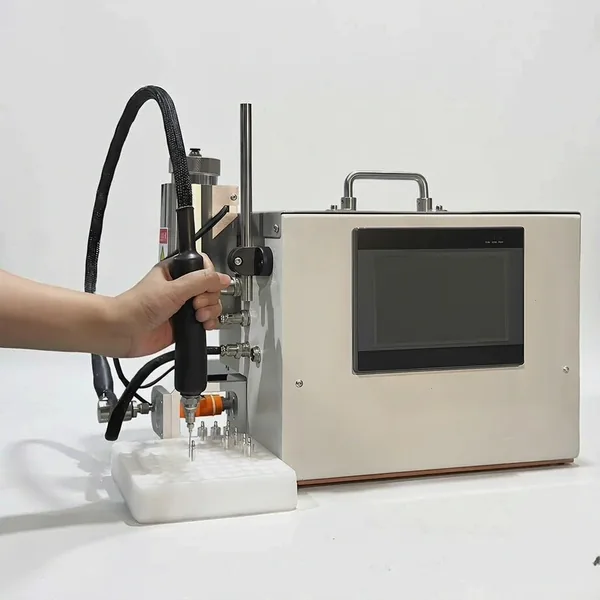
Longwill's hand-hose filling configuration provides another alternative.
It retains handheld nozzle positioning while using a separate reservoir and pumping arrangement, with temperature adjustments for the reservoir, pump, and hose.
This can be worth considering when direct access to the filling opening remains important but the material supply and temperature-control requirements call for a larger equipment arrangement.
The distinction among these options is not simply one of production scale.
FM03 emphasizes compact heated dispensing; FM10 emphasizes larger material supply and touchscreen operation; the hand-hose configuration combines direct positioning with a separate material-handling system.
Buyers should choose according to cartridge geometry, material requirements, target filling volume, and the preferred operating method.
Frequently Asked Questions
Is a cartridge filling gun the same as a manual syringe?
No. Although both may involve handheld positioning, a cartridge filling gun can include powered heating, temperature control, and assisted dispensing functions. Longwill's FM03 is a semi-automatic filling gun with a heated glass reservoir and controlled dispensing arrangement. A conventional manual syringe generally relies more directly on the operator to move the plunger and dispense the material. Buyers should compare the actual dosing mechanism and operating controls rather than assuming that every handheld tool works the same way.
How many cartridges can a 50 mL filling gun reservoir supply?
The nominal number depends on the target fill volume. At 1 mL per cartridge, 50 mL represents the theoretical material quantity for 50 cartridges. However, the amount actually dispensed before replenishment may be lower because some material can remain in the reservoir or dispensing path. Reservoir capacity should therefore be used for material planning, not as a guaranteed number of completed cartridges. Buyers should also consider the equipment's minimum operating volume and replenishment procedure.
Can a heated cartridge filling gun dispense thick distillate oil?
A heated filling gun may be suitable for certain viscous oils when its heating arrangement, dispensing mechanism, and needle match the formulation's processing requirements. The FM03 combines internal heating with a compact oil path for thick-oil filling applications. However, the appropriate temperature and operating conditions depend on the actual material. Heating alone does not establish universal compatibility with every concentrate or distillate formulation.
Does a short oil path always reduce oil waste?
No. A shorter oil path can reduce the number or length of components through which material travels, but actual residual material depends on the design of the reservoir, nozzle, seals, and other wetted parts. Cleaning and recovery procedures also affect how much material remains after production. The FM03's removable reservoir and compact dispensing path are useful structural features, but a specific material-saving percentage should not be assumed without application-specific information.
When is a bench-top cartridge filling machine preferable to a filling gun?
A bench-top machine may be preferable when repeated filling sessions require a larger reservoir, additional operating controls, or a different heated material-delivery arrangement. For example, the FM10 provides larger reservoir options and touchscreen settings, while Longwill's hand-hose system uses separate temperature controls across the material path. The decision should be based on the actual cartridge, formulation, batch requirements, and operator tasks rather than an arbitrary number of cartridges produced each day.
Choose the Right Filling Arrangement for Your Batch
A cartridge filling gun is not simply a smaller version of a cartridge filling machine. Its reservoir, heating design, dispensing path, and handheld operation create a different way of managing the filling task.
For compact batches, Longwill's FM03 offers a heated handheld arrangement with a removable 50 mL reservoir and short oil path. When production requires a larger oil supply or additional dispensing controls, the FM10 and semi-automatic hand-hose configurations provide alternatives without necessarily moving to a fully automatic production line.
Comparing filling equipment for your cartridges? Explore the Longwill FM03 Cartridge Filling Gun and semi-automatic cartridge filling solutions. Share your cartridge dimensions, target fill volume, material requirements, and typical batch quantity to discuss a suitable configuration.
Table of Contents