
Integrated vs Separate Cartridge Filling and Capping Machines
Choosing between an integrated filling-and-capping machine and two separate machines is an important decision for vape cartridge manufacturers. Both configurations can automate essential production steps, but they organize the filling and closing processes differently.
An integrated cartridge filling and capping machine combines both operations within one coordinated system. A separate-machine setup uses an independent cartridge filling machine and a dedicated capping machine, with cartridges transferred between them.
Neither configuration is automatically better. The right choice depends on cartridge compatibility, production volume, changeover requirements, available space, and how much control the manufacturer needs over each operation.
Quick Answer
Integrated filling and capping machines are generally worth considering for standardized cartridges and repeatable production. Separate machines offer more flexibility when filling and capping require independent adjustments, maintenance, or future upgrades. The best configuration depends on the complete cartridge assembly and production workflow.
Key Takeaways
- Integrated systems coordinate filling and capping within one equipment configuration, potentially reducing intermediate handling.
- Separate machines allow the filling and closing operations to be adjusted, maintained, or upgraded independently.
- Cartridge dimensions and mouthpiece design must be compatible with both processes, regardless of the equipment arrangement.
- Equipment cost should be evaluated alongside fixtures, changeovers, operator responsibilities, maintenance, and future production needs.
How Do Integrated and Separate Filling and Capping Machines Work?
The main difference is how the two production operations are connected.
A cartridge filling machine dispenses a controlled quantity of oil into a cartridge or compatible device. A capping machine then installs or secures the mouthpiece using the closing method required by the hardware.
These operations can be organized within one integrated machine or carried out at independent stations.
Integrated Filling and Capping Machines
An integrated machine combines filling and closing functions in a coordinated equipment arrangement.
The cartridge is positioned for filling and subsequently moves through the closing sequence supported by the machine. The exact sequence, cartridge transfer method, and level of automation depend on the model.
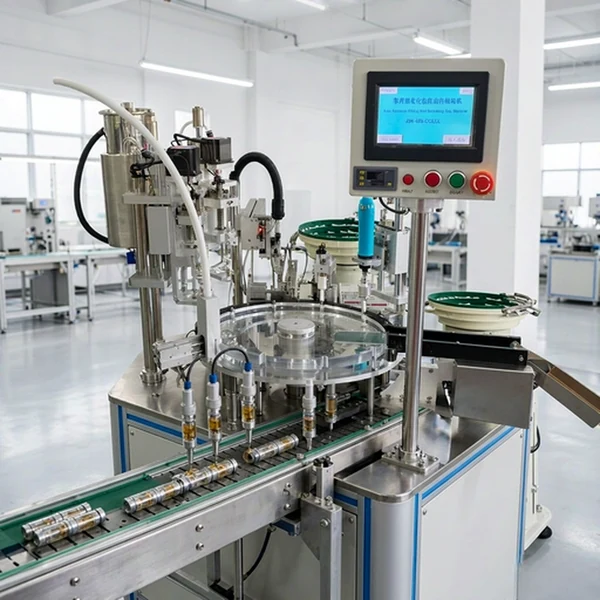
Longwill's FC-01 Automatic Cartridge Filling and Capping Machine is designed to coordinate these two operations.
It combines filling and capping functions with PLC-based control, touchscreen operation, and programmable settings. Product-specific program customization allows the equipment configuration to be discussed around the intended cartridge design.
The FC-01 offers a rated filling-and-capping capacity of 800–1,500 cartridges per hour, depending on the selected configuration and operating conditions.
The practical value of integration lies in coordinating the two processes within one equipment arrangement rather than treating them as unrelated production tasks.
Separate Filling and Capping Machines
A separate-machine configuration assigns filling and capping to different equipment.
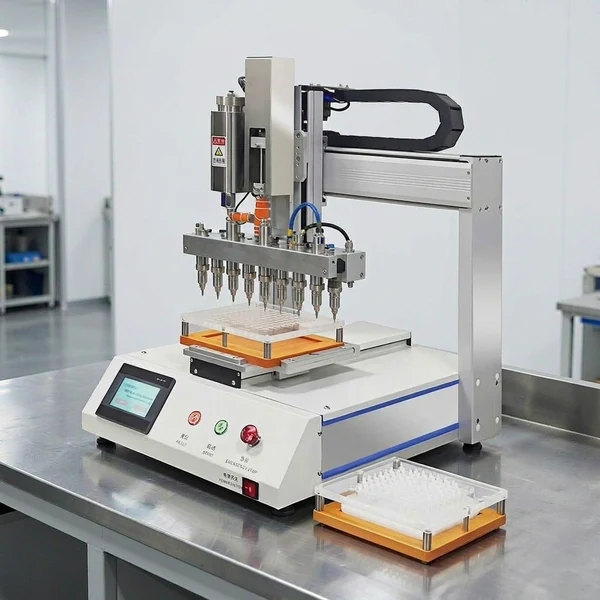
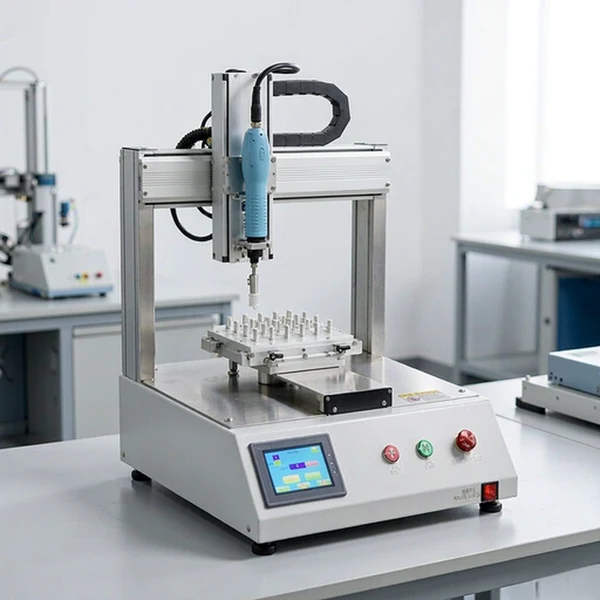
For example, a manufacturer may use Longwill's FM-07 Automatic Cartridge Filling Machine for programmable dispensing and a CM-05 Automatic Cartridge Capping Machine for compatible screw-type closures.
The FM-07 uses motor-driven positioning, customized filling trays, and touchscreen controls. The CM-05 provides motor-driven capping with adjustable settings for compatible cartridge hardware.
With separate equipment, filling and closing can be managed independently. However, cartridges must still be transferred between operations, either manually or through a separately designed handling system.
Buying two automatic machines does not by itself create an automatically linked production line. Transfer equipment, handling arrangements, and process coordination must be considered separately.
Integrated vs Separate Machines: What Actually Changes?
Both configurations can produce filled and capped cartridges, but they differ in the way equipment is organized and managed.
| Decision Factor | Integrated Filling and Capping | Separate Filling and Capping Machines |
|---|---|---|
| Process arrangement | Two operations coordinated within one machine | Filling and closing handled at independent stations |
| Cartridge handling | May reduce intermediate transfers within the supported workflow | Requires a defined transfer method between stations |
| Hardware compatibility | Both processes must work with the selected integrated configuration | Filling and closing compatibility can be evaluated separately |
| Changeovers | May require coordinated fixture and program adjustments | Each machine may need its own setup changes |
| Maintenance | Service work on a shared system may affect both operations | One machine may remain available when the other is serviced |
| Future expansion | Depends on the machine's available configuration and modification options | Filling or capping equipment can potentially be upgraded independently |
| Space planning | One combined machine footprint, plus operator and service clearance | Two footprints, transfer area, and access space |
| Initial investment | Depends on integrated functions and customization | Depends on both machines and any transfer equipment |
A compact integrated system can simplify production organization when the cartridge and closure remain consistent. Separate machines provide more independence, but that independence also requires additional coordination.
The most useful comparison is therefore based on how the equipment will operate in the buyer's facility, not simply the number of machines being purchased.
When Does an Integrated Filling and Capping Machine Make More Sense?
An integrated configuration becomes especially relevant when the manufacturer has a sufficiently standardized product and wants filling and closing to operate as a coordinated process.
Standardized Cartridge and Mouthpiece Designs
Consider a manufacturer producing one established cartridge format across repeated orders.
The cartridge dimensions, filling opening, mouthpiece, and closure method remain consistent. The manufacturer can therefore evaluate the filling and capping functions against one defined hardware assembly.
In this situation, an integrated system may reduce the need to organize separate equipment and repeated transfers between stations.
Longwill's FC-01 can be configured for applications where the filling and capping operations are compatible with the intended cartridge design.
However, approval for filling does not automatically establish compatibility with the closing operation. Both must be checked against the complete hardware design.
If the cartridge design changes later, new fixtures, program adjustments, or other equipment modifications may be required.
Production Workflows That Benefit From Coordinated Handling
Transferring filled cartridges from one station to another introduces handling tasks.
Depending on the factory arrangement, operators may need to unload a filling tray, move cartridges, prepare the capping station, and reposition the devices for closing.
An integrated configuration may reduce some of these intermediate steps by coordinating the processes within one machine.
This does not mean an integrated machine eliminates all manual handling. Operators may still need to load cartridges, replenish material, remove completed units, or perform inspections.
The level of automation depends on the equipment configuration.
For a manufacturer seeking a more coordinated filling-and-closing process, the benefit is the possibility of simplifying the workflow rather than an automatic guarantee of lower labor costs or higher production efficiency.
When Are Separate Cartridge Filling and Capping Machines More Practical?
Separate equipment can be an appropriate choice when filling and capping have different operating requirements or when the manufacturer wants greater independence between the two operations.
Different Production Schedules for Filling and Closing
Not every facility needs both machines to operate at the same time.
For example, a manufacturer may fill cartridges in batches and close them later, depending on the product's required handling and processing conditions.
A separate arrangement allows the two stations to be scheduled independently.
This can provide organizational flexibility, but the manufacturer must also manage any intermediate storage, transfer, traceability, and material-handling requirements.
The arrangement must remain consistent with the cartridge supplier's recommended filling-to-closing procedure.
Independent Equipment Maintenance and Replacement
Maintenance is another important difference.
With separate machines, a filling machine can potentially be serviced or replaced without changing the entire capping unit. The reverse is also true.
This can be useful when one operation requires a different equipment configuration as production changes.
For example, a manufacturer may later need additional filling positions while continuing to use an existing compatible capping machine.
Longwill's FM06 Automatic Filling Machine provides a six-nozzle filling arrangement with PLC-based control and configurable positioning.
It represents a different filling structure from the FM-07 and could be evaluated when production requirements change.
However, independent equipment does not guarantee uninterrupted production. If the remaining station has no suitable work available, its continued operation may not provide an immediate productivity benefit.
The advantage is the ability to make equipment decisions for each operation separately.
Cartridge Projects With Different Closing Requirements
Some manufacturers handle products requiring different mouthpiece structures or closing methods.
A filling arrangement may be suitable for several cartridges, while the closing operation requires a different machine or tooling.
For instance, a screw-type mouthpiece depends on controlled rotation, whereas a press-fit closure requires a suitable pressing arrangement and cartridge support.
These are different mechanical processes.
If a facility handles multiple closure types, separate equipment may be easier to evaluate and configure for individual closing requirements.
However, buyers should not assume that one capping machine supports every closure design.
Longwill's CM-05 uses motor-driven closing, and its suitability depends on the specific closure design and equipment configuration.
Why Mouthpiece Compatibility Can Decide the Equipment Architecture
One of the most important selection factors is often overlooked: the device must be compatible with both filling and capping.
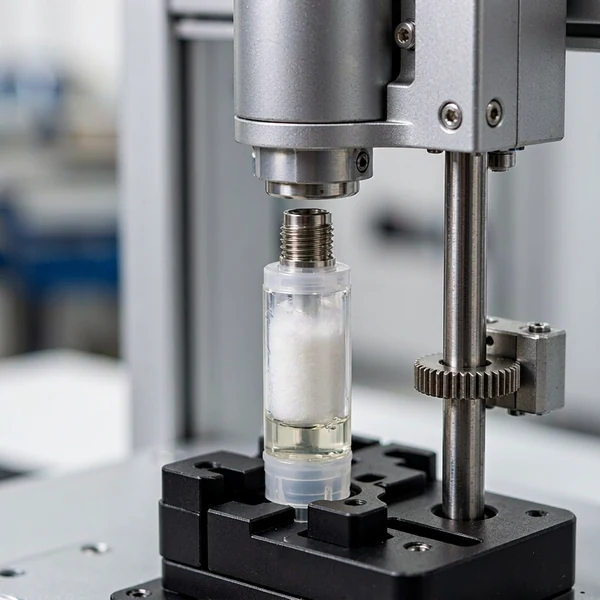
A cartridge may fit securely in a filling tray but require a different holding arrangement when the mouthpiece is installed.
The relevant dimensions and contact points are not necessarily the same.
For screw-type closures, the closing equipment must engage the mouthpiece correctly and apply the appropriate rotational movement. For press-fit closures, the equipment must support the cartridge body while applying controlled pressing force.
The closing process may also depend on the mouthpiece material, thread geometry, assembly tolerances, and cartridge supplier's instructions.
This creates a practical purchasing distinction.
With an integrated system, the buyer needs to confirm that the machine's filling and capping functions are both compatible with the intended assembly.
With separate equipment, the buyer can evaluate the two operations independently, but must still ensure that the cartridges can be transferred and handled without introducing additional problems.
A useful rule is to approve the complete cartridge assembly, not just the empty cartridge body.
Providing the reservoir without the intended mouthpiece is insufficient for evaluating a filling-and-capping solution.
For more information about hardware dimensions and filling compatibility, see Longwill's Cartridge, Pod, and Disposable Filling Machine Selection Guide.
What Should Buyers Consider About Cost, Space, and Maintenance?
A single integrated machine may appear simpler to purchase, while two separate machines may appear easier to expand.
Neither assumption is sufficient for an investment decision.
The total equipment requirement should include the machine configuration, fixtures, transfer arrangements, utilities, maintenance access, and any customization needed for the intended cartridge.
Equipment Investment and Future Upgrades
An integrated system includes coordinated functions within one machine, but its purchase price depends on the configuration and supported hardware.
Separate machines require individual equipment purchases and may also need transfer trays, additional work surfaces, or other handling arrangements.
If a business expects changes to one operation but not the other, the ability to upgrade separately may have value.
Conversely, if the filling and capping process is already standardized, an integrated configuration may be easier to organize.
There is no reliable universal percentage by which one option costs less than the other.
A meaningful comparison requires actual supplier quotations for equivalent application requirements.
Floor Space and Operator Access
Machine footprint should not be considered in isolation.
An integrated machine occupies one main equipment area but still requires access for loading, unloading, cleaning, adjustments, and maintenance.
Separate machines occupy individual spaces and need a suitable arrangement for moving cartridges between them.
Depending on the factory layout, separation may allow each operation to be placed where it is most convenient.
In other facilities, the additional transfer area may make the overall arrangement less compact.
The comparison should use equipment drawings and a proposed floor layout rather than assuming that one integrated machine always saves a fixed amount of space.
Cleaning and Production Changeovers
Material changes can require cleaning of the filling system, while hardware changes can affect the filling fixture, capping head, or operating program.
With integrated equipment, some of these changes may need to be coordinated before the next production run.
Separate equipment allows the two stations to be prepared independently, although this does not automatically make the overall changeover faster.
What matters is the actual work required to move from one approved product to another.
Manufacturers handling frequent changes should ask the supplier to identify the relevant change parts, adjustable settings, cleaning procedures, and expected operator tasks for their selected configuration.
How to Choose Between Longwill FC-01 and Separate Filling/Capping Equipment
Longwill provides both integrated and independent equipment options.
The FC-01 combines filling and capping within one programmable machine. The FM-07 and FM06 provide different automatic filling arrangements, while the CM-05 addresses compatible capping operations.
These machines should not be treated as interchangeable products. They represent different ways to organize the manufacturing process.
| Production Requirement | Configuration Worth Evaluating | Longwill Equipment Direction |
|---|---|---|
| Repeated production using a stable cartridge and closure | Integrated filling and capping | FC-01 |
| Existing filling machine with a need for compatible automated capping | Separate capping station | CM-05 |
| Independent control of filling and capping operations | Two-machine arrangement | FM-07 + CM-05, subject to compatibility |
| Need for a different automatic filling configuration | Independent filling equipment | FM06 or another suitable filling model |
| Multiple hardware or closure formats | Configuration-specific review | Evaluate filling and closing compatibility before selecting a system |
The table identifies starting points for an equipment discussion. It does not establish that every model combination is automatically compatible or that one arrangement is more economical.
The FC-01 uses PLC-based controls and product-specific programming. Its suitability should be evaluated using the complete cartridge assembly.
For independent equipment, the FM-07 provides programmable positioning and customized filling trays, while the CM-05 is designed for motor-driven capping of compatible hardware.
These features give buyers a practical basis for comparing the two approaches.
Rather than asking only, "Which machine is faster?", manufacturers should establish which equipment configuration supports their product and intended workflow with the fewest unnecessary changes.
What Should Be Confirmed Before Ordering?
The final decision should be based on a complete production requirement, not just a catalogue comparison.
For an integrated filling-and-capping project, provide both the cartridge and the intended mouthpiece or cap. The supplier needs to understand the filling opening, device dimensions, closure structure, and required assembly method.
For a separate-machine project, clarify how cartridges will move between the stations, whether the production schedule requires independent operation, and which fixtures or trays will be used at each stage.
The following questions can help resolve the main purchasing uncertainties:
- Does the selected configuration support the complete cartridge and mouthpiece assembly?
- Which operations are automated, and which still require an operator?
- Are cartridge transfers included in the proposed equipment configuration?
- What fixtures or change parts are required for different SKUs?
- Can the filling and capping functions be serviced or upgraded independently?
- What functions, accessories, and support are included in the quotation?
These questions help distinguish the actual scope of an integrated machine from a pair of separately purchased machines.
They also reduce the risk of assuming that two compatible individual operations will automatically form a coordinated production system.
Frequently Asked Questions
Is an integrated cartridge filling and capping machine better than two separate machines?
An integrated machine may be more suitable when the cartridge design and closing method are stable and the manufacturer wants coordinated filling and capping in one equipment configuration.
Separate machines may be preferable when the two operations require independent control, maintenance, or future upgrades.
Neither arrangement is universally better. Buyers should compare cartridge compatibility, production scheduling, available space, fixtures, operator requirements, and equipment costs before deciding.
The most appropriate configuration is the one that matches the actual hardware and workflow.
Does an integrated filling and capping machine eliminate manual handling?
Not necessarily. Integration means that filling and capping functions are coordinated within one equipment arrangement, but the level of automation varies by machine.
Operators may still need to load cartridges, replenish oil, remove completed products, change fixtures, or perform inspection tasks.
Buyers should review which operations the specific model automates rather than assuming that every integrated machine includes automatic feeding, inspection, and packaging.
For Longwill's FC-01, the proposed configuration and operator responsibilities should be confirmed before ordering.
Can I combine an existing filling machine with a new cartridge capping machine?
A separate capping machine can be added to an existing filling workflow if the hardware and operating requirements are compatible.
However, this does not automatically create an integrated production line. The cartridges must be transferred between stations, and the capping equipment must support the mouthpiece design, device dimensions, and closing method.
Buyers should also evaluate whether the filling output can be handled by the closing station.
Longwill's CM-05 is one capping option to review for compatible applications.
Do integrated cartridge filling and capping machines work with all 510 cartridges?
No. The term 510 describes a connection standard but does not define every cartridge's body dimensions, filling-port design, or mouthpiece structure.
Two 510 cartridges may require different fixtures or closing arrangements. An integrated machine must accommodate the complete hardware assembly, including both filling and capping.
Buyers should supply actual samples or detailed drawings and confirm whether the equipment configuration supports the selected cartridge.
Compatibility with one cartridge should not be assumed to extend to all devices described as 510 cartridges.
Which arrangement is easier to maintain or upgrade?
Separate machines offer more independence because filling and capping equipment can be serviced or replaced individually. This can be useful when a manufacturer plans to change only one operation.
An integrated machine combines the functions within one system, which may simplify process coordination but can make maintenance planning more interdependent.
Actual service access, spare parts, and upgrade options depend on the equipment design.
Manufacturers should ask suppliers how each function is accessed and which modifications are possible before comparing long-term maintenance requirements.
What information does Longwill need to recommend a filling and capping setup?
Longwill needs the cartridge dimensions, filling-port location, intended mouthpiece or cap, closure method, target filling volume, and relevant material information.
Expected batch sizes, production schedules, SKU variation, existing equipment, and available space are also useful.
For integrated equipment, provide the complete cartridge assembly so filling and capping requirements can be reviewed together.
For separate equipment, explain whether stations need to operate independently and how cartridges will be transferred.
These details help narrow the equipment configuration and clarify any customization requirements.
Choose a Filling and Capping Setup That Fits Your Workflow
The decision between integrated and separate cartridge filling and capping machines is ultimately a choice about how production should be organized.
An integrated configuration may simplify coordination for stable cartridge formats, while separate machines provide greater independence when filling and closing requirements change.
Longwill offers the FC-01 integrated filling-and-capping machine alongside separate automatic filling and capping equipment, giving manufacturers different options for their production requirements.
Planning a cartridge filling and capping project? Explore Longwill's cartridge filling and capping equipment and share your cartridge samples or drawings, mouthpiece design, filling volume, material information, and production requirements. The Longwill team can discuss an appropriate integrated or separate equipment configuration for your application.