
Can a Dab Dispenser Fill Badder at Room Temperature? What Buyers Should Test
When evaluating the Longwill FM18 for Badder filling, one concentrate processor raised a practical question: could the machine dispense Badder at room temperature without first heating it into a more fluid state?
The buyer wanted more than a simple equipment demonstration. They asked for a continuous 30-jar filling test, including the material temperature, target weight, actual net weight of each jar, and the amount of concentrate left inside the machine. Cleaning and material changeover were also part of the evaluation.
These requirements reflect a common concern among concentrate manufacturers. A dab dispenser may be designed for thick materials, but that alone does not establish whether it can handle a particular Badder formulation consistently.
For manufacturers considering automated filling, the key is to understand how material consistency, feeding mechanisms, dosing accuracy, and operating conditions work together. Here is what to evaluate before choosing a machine for room-temperature Badder filling.
Why Is Badder Difficult to Fill at Room Temperature?
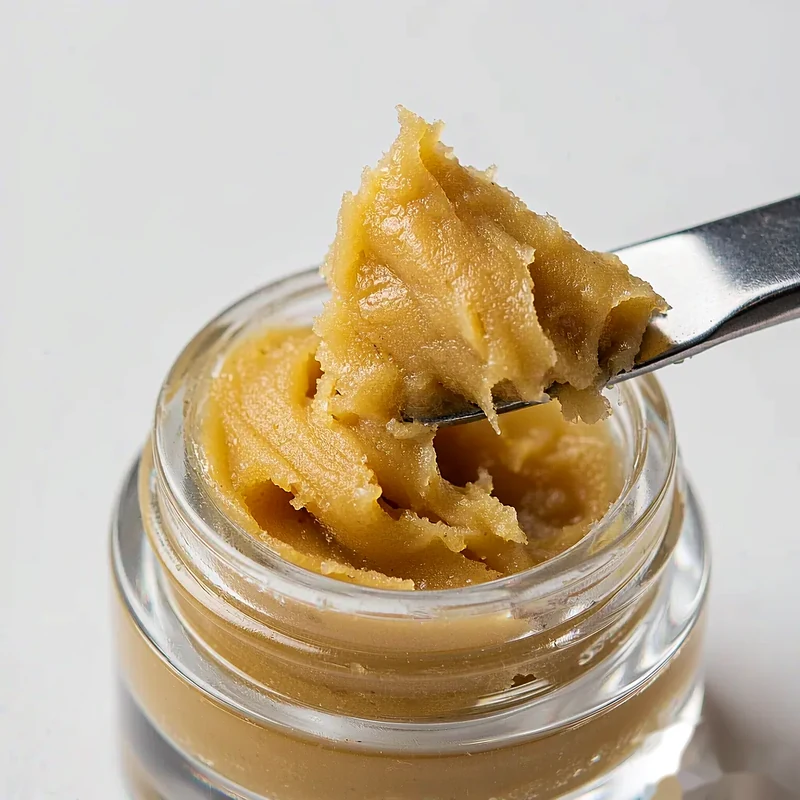
Badder has a thick, butter-like consistency that makes it behave differently from liquid concentrates. It does not flow easily under gravity, and its resistance to movement can make feeding and dispensing more demanding.
For automated production, the challenge is maintaining a steady supply of material while delivering a repeatable quantity into each jar. Variations in texture or feeding conditions can affect the filling cycle, especially when the machine runs continuously.
How Badder's Consistency Affects Material Flow
Badder can vary in texture depending on its formulation, processing conditions, and storage environment. Some batches may be relatively soft and workable, while others are denser and more resistant to movement.
These differences influence how the material travels through a filling system. If the feeding mechanism cannot move the concentrate consistently toward the dispensing outlet, operators may encounter irregular output, incomplete dispensing, or variations between jars.
This is why a general demonstration using one concentrate is not enough to establish compatibility with another. A machine that handles one formulation successfully may require different settings or operating conditions when processing a denser batch.
Why Conventional Filling Methods May Cause Inconsistent Dosing
Gravity-based feeding and conventional liquid filling methods are not always suitable for thick concentrates.
When material does not move consistently toward the outlet, the filling system may struggle to maintain a stable dispensing cycle. Air trapped in the material path, irregular feeding pressure, and concentrate remaining inside the machine can also influence the final output.
For high-viscosity concentrate filling, the feeding mechanism needs to match the material's physical characteristics. Simply using a filling system designed for thinner oils may not deliver the same results.
Can a Dab Dispenser Handle Badder Without Heating?
Yes, certain dispensing systems can handle suitable concentrate formulations without additional heating. However, this depends on the material's consistency and the machine's feeding design. Not every Badder formulation will behave the same way at room temperature.
The first thing to examine is how the machine transfers thick material from the reservoir to the dispensing nozzle.
Screw Pump vs. Pressure-Based Feeding
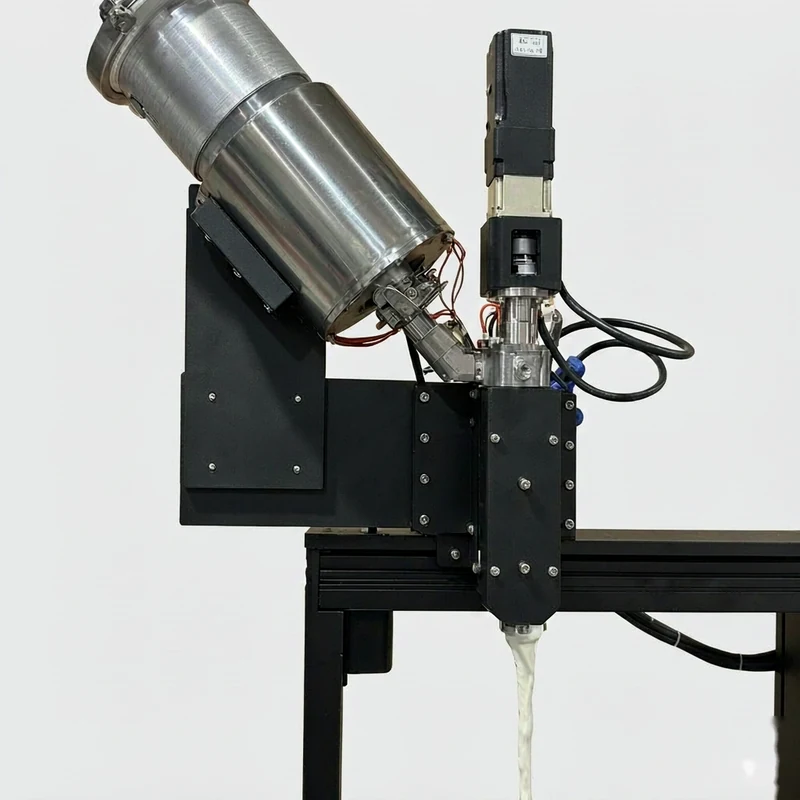
A screw pump uses a rotating mechanism to move material through the filling path. Rather than depending primarily on gravity or compressed air, it mechanically transfers the concentrate toward the dispensing outlet.
This approach is useful when handling dense materials because the feeding process can be controlled through the pump's operation.
Pressure-based systems work differently. They use applied pressure to move material through the system, and their performance depends on maintaining suitable feeding conditions.
When comparing these methods, buyers should consider several practical factors:
Whether the feeding mechanism can handle the actual material consistency.
Whether material delivery remains stable throughout the filling cycle.
Whether trapped air or pressure fluctuations affect the output.
How easily the material path can be accessed and cleaned.
Neither mechanism should be assumed to work equally well with every concentrate. Testing the same material under comparable conditions is a more reliable way to evaluate performance.
When Is an Optional Heating System Necessary?
Heating can reduce material resistance to flow, making some concentrates easier to transfer and dispense. However, additional heat is not automatically necessary for every Badder formulation.
If the concentrate can be fed and dispensed consistently without heating, room-temperature operation may help avoid unnecessary changes to its original handling conditions.
For denser materials, controlled heating may be considered when the feeding system requires additional assistance. The appropriate temperature depends on the formulation and its processing requirements.
Before purchasing a machine, ask the supplier which components support heating, how temperature is controlled, and whether the actual concentrate has been tested under both heated and unheated conditions.
A room-temperature filling claim should always be supported by a test using the intended material, rather than inferred from the machine's general ability to handle high-viscosity products.
How to Test Badder Filling Accuracy and Consistency
A machine's stated filling accuracy is only one part of its performance. For concentrate manufacturers, the more important question is whether the equipment can maintain the required fill weight throughout a production run.
A useful evaluation should cover individual jar weights, consecutive filling performance, and the conditions under which the results are obtained.
Check the Target Weight Against Actual Net Weight
Start by defining the target filling weight for the intended container.
For example, if the production requirement is 1g per jar, the test should record the actual net concentrate weight in each jar rather than relying only on the programmed dispensing setting.
A suitable test record should include:
Target filling weight.
Actual net weight of each sample.
Average filling weight.
Maximum deviation from the target.
Number of samples tested.
The difference between programmed output and actual net weight matters because material density, feeding conditions, and dispensing behavior can influence the final result.
Evaluate Consistency Across Consecutive Jars
Testing only one or two jars does not provide enough information about production consistency.
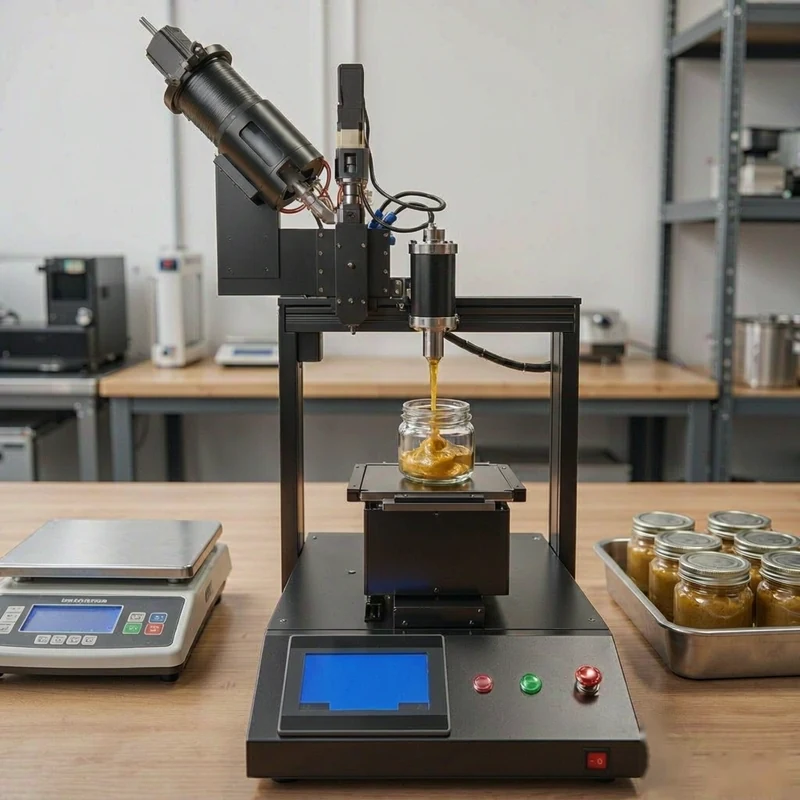
For a more meaningful evaluation, buyers can request a consecutive 30-jar test using the same Badder formulation, container type, and target filling weight.
Record the weight of each jar and compare the results from the beginning, middle, and end of the test.
This helps identify whether the machine maintains stable output or develops variations as the material level changes or the production cycle continues.
The test should also document any interruptions, manual adjustments, or nozzle cleaning required during the run.
Record Material Temperature and Filling Conditions
Temperature can affect how Badder moves through a dispensing system. Therefore, a filling test should document the material temperature and surrounding conditions.
At a minimum, record:
Ambient temperature.
Actual material temperature.
Whether the heating function is enabled.
Target filling weight.
Feeding and dispensing settings.
Without these details, it is difficult to determine whether the results can be reproduced in the buyer's actual production environment.
A test conducted with heated material should not be presented as evidence of room-temperature filling performance.
What About Material Residue and Cleaning Between Batches?
Filling accuracy is important, but it is not the only factor affecting production efficiency.
Thick concentrates can remain inside reservoirs, feeding components, transfer paths, and dispensing nozzles. If these areas are difficult to access, material changeover may require additional labor and create unnecessary product loss.
Where Can High-Viscosity Concentrates Remain?
Material residue can accumulate at connection points, internal surfaces, pump components, and nozzle outlets.
The amount depends on the machine structure, concentrate consistency, filling conditions, and the design of the material path.
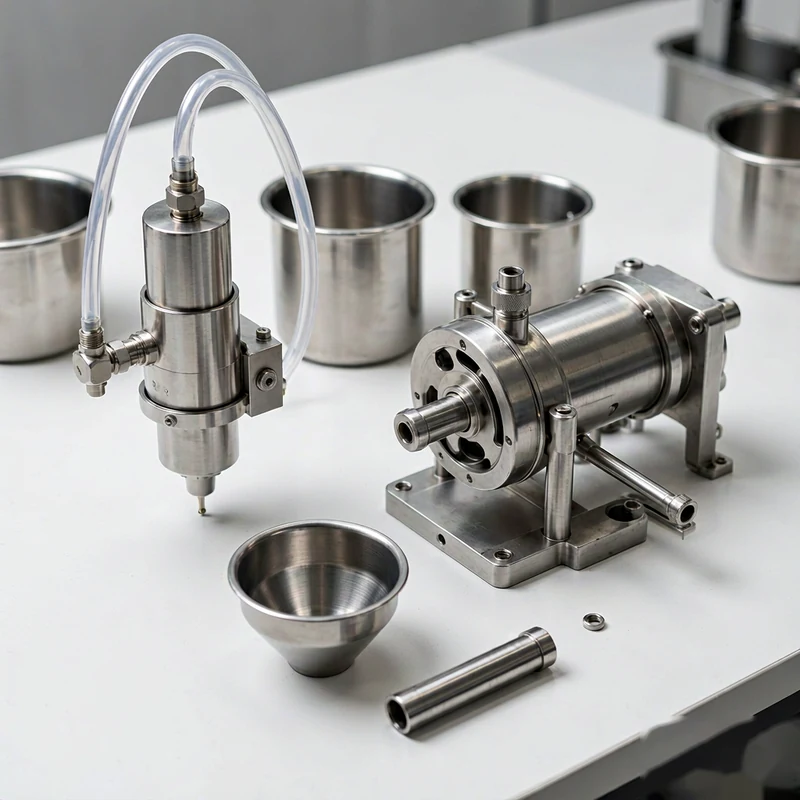
During a machine demonstration, buyers should check whether the system can be opened and inspected easily, whether product-contact components can be removed for cleaning, and whether material remains in areas that are difficult to reach.
It is also useful to distinguish between normal residual material inside the system and actual material loss during a production batch.
What to Check During Cleaning and Material Changeover
A cleaning demonstration is more useful than a general statement that a machine is easy to clean.
Ask the supplier to demonstrate the complete process, including:
Emptying the remaining concentrate.
Removing accessible product-contact components.
Cleaning the reservoir, pump, and nozzle.
Reassembling the material path.
Preparing the machine for the next filling batch.
If the production line handles multiple concentrate formulations, changeover time and cross-batch residue should also be considered during equipment selection.
What Should You Ask Before Buying a Dab Dispenser?
Before purchasing a dab dispenser, buyers should request a test using their actual concentrate and packaging specifications.
A useful equipment evaluation should cover more than the machine's advertised speed or filling accuracy.
1. Can the machine fill your actual Badder formulation at room temperature?
Ask whether the supplier has tested the same or a comparable material without additional heating. Request the material temperature and a demonstration of the complete filling process.
2. Can the supplier provide consecutive jar-weight records?
Request individual net-weight results from a continuous test, rather than relying only on a stated accuracy figure.
3. How much material remains inside the machine?
Ask for information about residual material after a defined production batch and how the remaining concentrate is recovered or removed.
4. How long does cleaning and material changeover take?
A practical demonstration should show the accessible components, cleaning steps, and preparation required before the next batch.
5. Can the machine accommodate your container and filling requirements?
Confirm the container dimensions, target filling weight, dispensing range, production speed, and any special requirements for your packaging format.
These questions help manufacturers compare equipment based on actual production needs rather than specifications obtained under different testing conditions.
How Does the Longwill FM18 Handle Thick Concentrate Filling?
For manufacturers looking for an automated solution to handle thick concentrates, the Longwill FM18 Automatic Dab Wax Filling Machine combines controlled material feeding with programmable dispensing.
Its configuration includes an air-free feeding system, a motor-driven screw pump, and PLC-controlled operation. The machine supports room-temperature filling, while an optional heating system is available for applications that require temperature assistance.
FM18 offers a programmable dosing range of 0.1–10g, a stated filling accuracy of ±0.01g, and an output of approximately 20–30 jars per minute. These figures should be evaluated against the actual concentrate, target filling weight, and container format, as production results may vary with application conditions.
The machine is designed for concentrates including Wax, Live Resin, Live Rosin, Budder, and other high-viscosity materials, with Badder also listed among its intended applications.
For manufacturers specifically evaluating room-temperature Badder filling, the most useful next step is to run a test using their own formulation. The evaluation should include consecutive jar weights, material temperature, feeding stability, residual material, and cleaning procedures.
If you are comparing concentrate dispensers for your production line, share your material type, target filling weight, jar dimensions, and expected output with Longwill. Our team can review your requirements and help determine the appropriate machine configuration and testing conditions.
Explore the Longwill FM18 Automatic Dab Wax Filling Machine or contact our team to discuss your concentrate filling requirements.
Frequently Asked Questions
Can Badder be dispensed without heating?
Some Badder formulations can be dispensed without additional heating when the feeding mechanism is suitable for their consistency. However, results depend on the specific material and machine configuration. Testing with the actual formulation is recommended before production.
Does higher viscosity affect dab filling accuracy?
Yes. Higher viscosity can affect material feeding and dispensing stability. If the feeding mechanism cannot maintain consistent material transfer, the actual amount dispensed may vary. The machine should therefore be tested with the intended concentrate and target filling weight.
How can I check weight consistency across 30 jars?
Weigh each filled jar individually and record its net concentrate weight. Compare the results against the target weight, then calculate the average and maximum deviation. Also record any interruptions or manual adjustments during the test.
How much concentrate remains inside a filling machine?
Residual material depends on the reservoir, pump, transfer path, nozzle design, and concentrate consistency. Ask the supplier to demonstrate material recovery and cleaning using a defined test batch rather than relying on a general waste percentage.
Can one dab dispenser handle different concentrate consistencies?
Some machines are designed for multiple concentrate types, but compatibility should be confirmed individually. Different formulations may require adjustments to feeding conditions, dispensing settings, or temperature control.
What should I provide for a Badder filling machine test?
Provide a representative material sample, target filling weight, jar dimensions, expected production output, and required operating temperature. If possible, also specify cleaning and material changeover requirements. This allows the supplier to evaluate the application under conditions closer to your actual production needs.
Table of Contents