
What Causes Vape Cartridge Filling Accuracy Problems? Pumps, Nozzles, and Process Variables Explained
Cartridge filling accuracy depends on more than the dose entered on a control screen. The final result is shaped by how the material enters the metering system, how consistently the pump displaces it, what happens at the nozzle, whether the cartridge remains correctly positioned, and how the filled units are measured.
This explains why an automatic cartridge filling machine may perform consistently during an initial test but show wider variation after a material change, long production run, nozzle replacement, or hardware change. The machine may still be operating normally while the conditions around the original settings have changed.
A useful investigation separates the filling process into four questions: Did the pump meter the intended dose? Did the complete dose leave the nozzle? Did it enter the correct part of the cartridge? Was the final result measured correctly? Checking these stages individually is more reliable than adjusting the dose setting every time an underfill or overfill appears.
What Cartridge Filling Accuracy Actually Means
Cartridge filling accuracy describes the difference between the target dose and the quantity actually delivered into the hardware. It is not the same as repeatability, controller resolution, or visual fill height.
Accuracy shows how close a result is to the target. Repeatability shows how closely multiple results agree with one another. A system can produce nearly identical doses that are all below the target, which means it is repeatable but not accurate. A batch average can also appear correct while individual cartridges vary beyond the acceptable range.
The basic calculation is:
Fill error (%) = (Measured dose − Target dose) ÷ Target dose × 100
If the target dose is 1.00 g and the measured net dose is 0.98 g, the error is −2%. One sample, however, cannot represent the performance of a production process. A meaningful test should use a defined sample size and record the average, minimum, maximum, and spread.
| Measurement | What it shows | What it does not establish |
|---|---|---|
| Average net fill | Whether the process is centered near the target | Whether every cartridge is within tolerance |
| Fill-to-fill spread | How repeatable the process is | Whether the average dose is correct |
| Visual fill level | Whether a unit looks abnormal or contaminated | Exact delivered quantity |
| Controller setting | The programmed dispensing value | The amount retained in the cartridge |
| Display increment | The smallest available setting change | Complete system accuracy |
Visual oil level answers a different question. Cartridge geometry, internal components, planned headspace, and oil entering the intake structure can make two correctly dosed cartridges appear to have different levels. Visual inspection remains useful for finding spills, center-airway contamination, or abnormal units, but it should not replace net-weight measurement.
How the Pump Influences Dosing Accuracy
The pump or metering mechanism controls how much material is displaced during each filling cycle. Its performance depends on both the programmed movement and the condition of the material entering the measuring chamber.
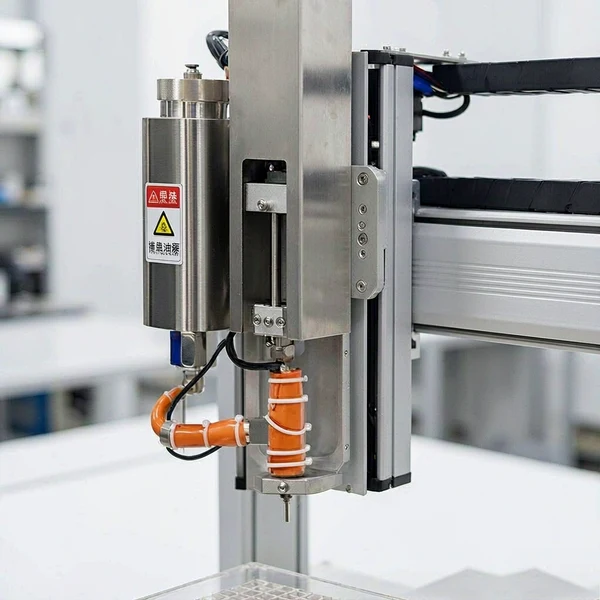
Air in the oil path is a common source of underfilling and unstable delivery. Part of the pump movement may compress or move the trapped air instead of dispensing material. The result can be incomplete doses, delayed output, or wider variation after the reservoir has been refilled. Air may enter while loading material, reconnecting tubing, or allowing the reservoir level to fall too low.
Mechanical condition also matters. Seals, pistons, valves, and other moving components can gradually wear, changing the relationship between programmed movement and actual output. Because this change develops over time, the dosing result may drift even though the operator has not adjusted the settings.
Flexible tubing can expand slightly under pressure, particularly when a thick material creates greater flow resistance. Loose connections, damaged seals, or unsuitable tubing may add further variation or allow material to escape before it reaches the nozzle.
For these reasons, the metering system should be evaluated with the intended material and target dose. Calibration performed with a low-viscosity test liquid may not predict how the same system will handle a thick concentrate because pressure, flow resistance, and nozzle cut-off conditions can differ substantially.
How Nozzles Cause Underfills, Overfills, and Dripping
The nozzle is the final control point between the metering system and the cartridge. Even when the pump displaces the correct quantity, the retained dose can change if material remains on the nozzle, drips after the cycle, or lands outside the intended chamber.
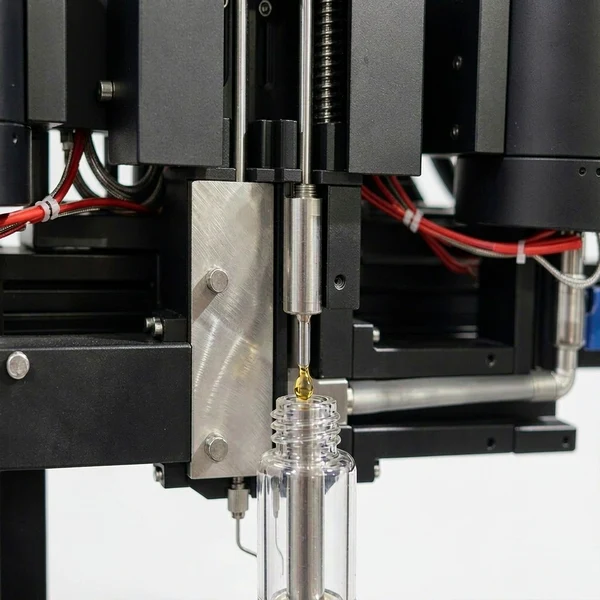
A nozzle that is too narrow for the material can increase back pressure and extend the time required to complete the dose. If the production cycle advances before the material has fully exited, the cartridge may receive less than intended while the remaining material appears later as a delayed drip.
A larger nozzle is not automatically better. When the filling opening is narrow, an oversized tip can reduce placement clearance and make it difficult to position the nozzle between the cartridge wall and center airway. Nozzle selection must balance material flow with the available filling-port space.
The exposed nozzle can also cool during a production pause even when the reservoir and internal oil path remain controlled. Material near the tip may then behave differently during the first few cycles after production restarts.
Residue around the nozzle changes the cut-off point and can cause stringing, exterior contamination, or post-fill dripping. This creates a difference between the amount displaced by the pump and the amount that remains inside the cartridge.
When investigating the nozzle, check its internal diameter and length, filling-port clearance, insertion position, residual material after cut-off, dripping behaviour, and cleaning condition. These factors should be evaluated together rather than selecting a needle from diameter alone.
Why Viscosity Changes the Filling Result
Viscosity affects how easily material moves through the reservoir, pump, tubing, and nozzle. As viscosity rises, the system must overcome greater flow resistance. When it falls, material may leave the nozzle more quickly and continue moving after the metering cycle stops.
Temperature can change viscosity, but it is not the only variable. Formulation, batch uniformity, residence time, and material condition can also alter flow behaviour. Two oils within the same broad material category may therefore require different filling speeds, nozzle sizes, or calibration values. Where the material is thick enough to behave like a wax or concentrate, a machine configured as a Dab Wax Filling Machine may be the more suitable choice.
Accuracy problems often begin when a production team loads a new material but continues using settings established for a previous batch. The target dose may remain unchanged while pump response, dispensing time, cut-off behaviour, and dripping have all shifted.
The objective is not to apply the highest available temperature. It is to establish a controlled condition in which the material can be dispensed consistently without exceeding the limits defined for the formulation or hardware. That condition should be established through material-specific testing rather than a universal temperature value.
Material condition should also remain reasonably stable during longer runs. Temperature gradients inside the reservoir or non-uniform material can cause the beginning and end of a batch to behave differently, even when all machine settings remain unchanged.
Why Calibration Must Match Production Conditions
Cartridge filling calibration connects the controller setting to the dose that actually reaches the cartridge. It should be completed after the machine has been prepared with the intended material, nozzle, oil path, hardware, and operating condition.

A calibration may no longer be valid after the nozzle, tubing, material, target dose, or operating condition changes. Each of these factors can alter the relationship between pump movement and delivered quantity.
The weighing procedure also needs to remain consistent. Empty hardware should be weighed individually or tared before filling, and the filled units should be measured with a scale that has suitable capacity and resolution. Changing the weighing method during a test can introduce variation that is unrelated to the filling machine.
A practical calibration sequence begins by preparing the machine with the production material and hardware. The oil path is then primed until trapped air and incomplete first doses have been removed. A defined group of samples is filled and weighed, after which the average result is used to adjust the setting. A second sample group is then measured to confirm both accuracy and repeatability.
Calibration should be verified after material changes, maintenance, or replacement of components that affect the oil path. Periodic production checks are more reliable than assuming that the first calibration remains valid indefinitely.
Hardware Alignment Can Resemble a Metering Error
A correctly metered dose can still produce an underfilled cartridge when the nozzle is not aligned with the intended filling area. Material deposited on the cartridge rim, center airway, or fixture has left the pump but has not remained inside the reservoir.
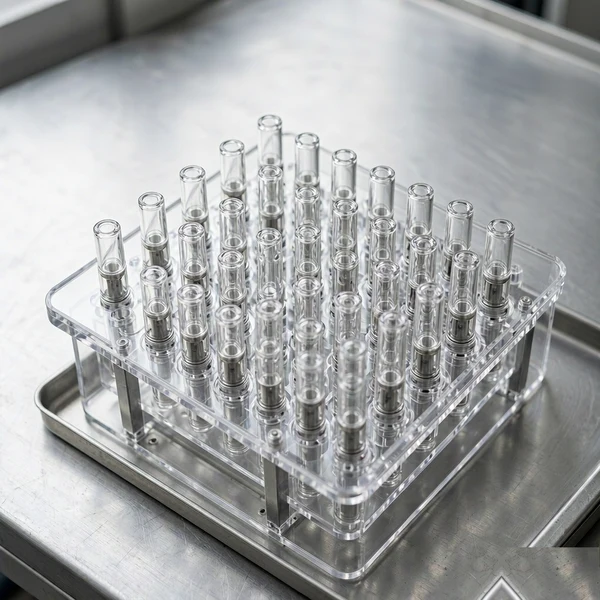
The tray is therefore part of the accuracy system. Each cartridge must sit at a consistent height and orientation, and the fixture should limit movement during the filling cycle. Loose tray pockets can cause the filling port to shift relative to the programmed nozzle coordinates.
Hardware variation creates a similar risk. A tray developed around one sample may not position a later production batch identically if the body dimensions or filling-port location have changed. New hardware batches should be checked before full production, particularly when the available clearance around the filling port is limited.
For multi-nozzle machines, alignment and weight results should be reviewed by nozzle position. A batch average can conceal one restricted nozzle or one misaligned tray position if the remaining positions are operating correctly.
Process Variables That Change Production Accuracy
Accuracy testing usually takes place under stable conditions, while normal production includes startup, pauses, reservoir refilling, shift changes, maintenance, and multiple operators. These events can widen the result even when the machine itself is capable of consistent dosing.
The first units after startup or a long pause may behave differently because the oil path has not yet reached a stable state. Refilling the reservoir can introduce air or change the material condition. Increasing cycle speed may reduce the time available for the dose to exit fully or for the nozzle to achieve a clean cut-off.
Maintenance directly affects the process as well. Nozzle residue, worn seals, loose tubing connections, and incomplete cleaning can alter flow resistance or allow leakage. On a multi-head machine, each oil path should be inspected and tested separately.
Automation also depends on correct operation. Incorrect tray loading, selection of the wrong program, incomplete priming, or skipped weight checks can create variation that appears to be a mechanical accuracy problem.
| Observed problem | Areas to check first | Useful verification |
|---|---|---|
| All units remain below target | Calibration, target setting, trapped air | Re-prime and compare net weights |
| Results vary unpredictably | Air bubbles, material condition, tubing connections | Observe the oil path and repeat a controlled test |
| One nozzle produces different results | Restriction, residue, height, or alignment | Compare net fills by nozzle position |
| First units after a pause are different | Nozzle cooling, settling, or incomplete priming | Separate startup samples from steady-run samples |
| Weight is correct but fill level looks low | Hardware geometry, headspace, or oil absorption | Use net weight rather than appearance |
| Oil appears outside the cartridge | Tray fit, nozzle coordinates, or delayed dripping | Inspect positioning and nozzle cut-off |
| Accuracy changes after switching oils | Viscosity, material condition, and calibration | Recalibrate with the new material |
How to Evaluate an Automatic Filling System
A stated accuracy figure becomes useful only when the test conditions behind it are understood. Buyers should ask which model was tested, what dose and material were used, how many samples were measured, what production speed was selected, and whether the result represents maximum error, average error, or repeatability.
These terms are not interchangeable. A machine may produce a good average while showing a wide individual spread, or it may repeat an incorrect dose very consistently. The acceptance method should therefore define both the target average and the permitted range for individual units.
For buyers evaluating Longwill equipment, the FM-07 Auto Robo is a tray-based model with programmable filling positions and a specified ±1% filling accuracy. That figure should be assessed within the actual production configuration, including the selected dose, material, nozzle, tray, speed, and weighing method. It should not be treated as an unconditional result for every oil or cartridge.
A useful equipment trial should include the buyer’s representative material and actual hardware. Startup samples, steady-run samples, and results from every active nozzle or tray position should be measured separately. If the planned production includes several oils or cartridge formats, the important combinations should be tested individually.
Cartridge Filling Accuracy Acceptance Matrix
This matrix turns a general accuracy claim into a testable purchasing requirement. It also gives the buyer and supplier a common basis for evaluating the machine before production begins.
| Acceptance item | What to define before testing | Why it matters |
|---|---|---|
| Target dose | Exact mass or volume for the selected hardware | Establishes the reference value |
| Error calculation | Formula and permitted tolerance | Prevents different interpretations of accuracy |
| Sample size | Number of units and test cycles | One successful fill is not representative |
| Test material | Production oil or an agreed equivalent | Material resistance affects pump and nozzle behaviour |
| Operating condition | Material condition and machine settings | Keeps results comparable |
| Cartridge hardware | Exact model, dimensions, and batch | Confirms tray and nozzle alignment |
| Nozzle configuration | Size, quantity, and active positions | Identifies differences between filling heads |
| Production speed | Speed used during the test | Slow testing may not represent production output |
| Measurement equipment | Scale capacity, resolution, and tare method | Reduces measurement uncertainty |
| Pass criteria | Average, individual limits, and repeatability | Defines a clear acceptance decision |
FAQ
Why is the dose correct during calibration but inconsistent in production?
Calibration is often completed under more stable conditions than normal production. Material condition, nozzle temperature, reservoir refilling, trapped air, speed changes, and production pauses can alter flow after the initial setup. Samples should therefore be checked at startup and during steady operation rather than only during calibration.
Does a smaller dosing increment mean higher filling accuracy?
Not necessarily. A smaller increment allows finer adjustment of the programmed value, but actual accuracy still depends on the pump, nozzle, tubing, material condition, cartridge alignment, and measurement method. Controller resolution and complete-system accuracy describe different characteristics.
Can the same calibration be used for different vape oils?
It should not be assumed. Different materials can create different flow resistance, pressure response, and nozzle cut-off behaviour. After an oil change, the delivered net dose should be verified and the calibration adjusted when necessary before the full production batch begins.
Why does one nozzle fill differently from the others?
A single nozzle may contain residue, have a different internal restriction, sit at another height, or align differently with the cartridge. Results should be recorded by nozzle position so that the affected oil path and tray location can be identified.
Does a cartridge that looks underfilled always indicate an accuracy problem?
No. Visual fill level can change with cartridge geometry, internal components, planned headspace, and oil entering the intake structure. Net weight is a better measure of delivered quantity, while visual inspection is better for identifying spills, airway contamination, and abnormal units.
What should be defined before an equipment accuracy test?
The test should define the machine model, cartridge, material, target dose, operating condition, speed, nozzle configuration, sample size, weighing method, and acceptance limits. Without these conditions, a percentage cannot be applied reliably to a different production setup.
Build Accuracy Around the Complete Filling Process
Reliable cartridge filling is not determined by the pump specification alone. It comes from the interaction between metering, material condition, oil-path preparation, nozzle selection, hardware positioning, calibration, and production checks.
Before selecting a configuration, provide the actual cartridge, representative material, target dose, expected output, and acceptance criteria. This makes it possible to evaluate the machine under conditions that reflect the intended production process rather than relying on a single headline specification.